
Quick answer: For most print projects, PNG and SVG are all you need. PDF is rarely necessary for QR codes specifically—the formats you actually need are the ones that go inside the PDF you're designing.
If you've ever stared at the export options wondering "Which format do I actually need?"—you're not alone. Let's clear up the confusion once and for all.
The Short Version (If You're in a Hurry)
Use PNG when: You need a QR code for digital use, quick prints, or inserting into documents. It's the most versatile format.
Use SVG when: You need the code for large prints (bigger than a business card), professional design work, or when a designer asks for "vector."
Skip PDF: Most QR generators that offer PDF are just wrapping a PNG or SVG in a PDF container. You're better off getting the raw image file and placing it yourself.
What Each Format Actually Is
Let's break these down in plain English—no computer science degree required.
PNG: The Reliable Workhorse
PNG (Portable Network Graphics) is a standard image format, like a digital photograph. When you export a QR code as PNG:
- The image has a specific size (measured in pixels)
- It looks perfect at that size or smaller
- It can start looking fuzzy if you stretch it too large
- Works everywhere—websites, documents, emails, you name it
Best for: Business cards, flyers, social media, websites, presentations, small to medium printed materials (up to about poster size at 300 DPI).
Quality QR exports PNG at 1024x1024 pixels by default, which is large enough for most print jobs up to about 8 inches at high quality.
SVG: The Infinitely Scalable Option
SVG (Scalable Vector Graphics) works differently. Instead of storing pixels, it stores mathematical instructions for drawing the QR code. This means:
- You can make it any size without losing quality
- A thumbnail and a billboard look equally sharp
- The file size stays tiny regardless of output size
- Perfect for professional design software
Best for: Billboards, vehicle wraps, large banners, professional design work, anywhere you need flexibility in sizing.
PDF: Mostly Unnecessary for QR Codes
Here's what most people don't realize: PDF is a document format, not really an image format. When a QR generator exports to PDF, it's usually just putting a PNG or SVG inside a PDF wrapper.
This adds an extra step without adding value. Your designer or print shop will likely extract the image anyway. Just use PNG or SVG directly.
Real-World Use Cases
Let's match formats to actual projects you might be working on:
Business Cards
Use PNG. Business cards are small, and a 1024px PNG gives you more than enough resolution. Even a 512px PNG works fine at business card size.
Restaurant Menus
Use PNG for table tents and inserts. If you're printing large wall menus, consider SVG for extra sharpness.
Product Packaging
Use SVG. Packaging often goes through professional design workflows, and designers prefer vector files. SVG gives them flexibility.
Billboards and Large Signage
Use SVG. When prints get this large, you absolutely need vector. A PNG would need to be enormous to maintain quality.
Websites and Digital Marketing
Use PNG. It's universally supported and the file sizes are reasonable. Most websites can't even display SVG properly in all contexts.
Social Media Posts
Use PNG. Social platforms compress images anyway, and PNG handles this gracefully.
The Printing Resolution Rule
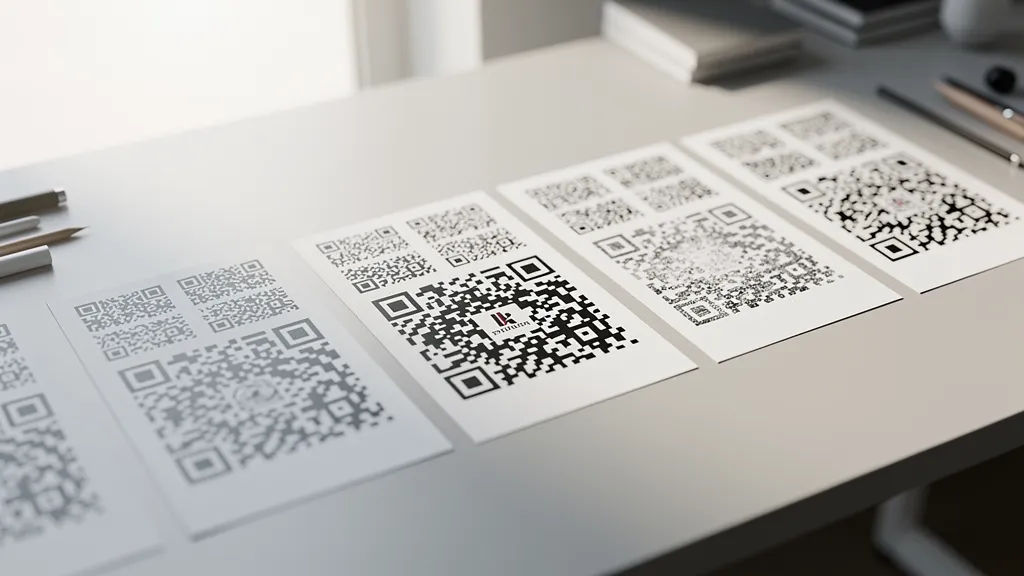
Here's a simple guideline for print: you need about 300 pixels per inch (PPI) for sharp prints.
With a 1024×1024 pixel PNG:
| Print Size | Quality |
|---|---|
| Up to 3 inches | Excellent |
| 3-6 inches | Great |
| 6-8 inches | Good |
| 8+ inches | Consider SVG |
For anything larger than 8 inches, SVG guarantees perfect quality at any size.
Common Mistakes to Avoid
Mistake 1: Stretching a Small PNG
If you download a 200px QR code and stretch it to fit a poster, it will look pixelated and may not scan reliably. Always export at a size larger than you need, or use SVG.
Mistake 2: Using JPEG Instead of PNG
JPEG compression can blur the sharp edges of QR codes, potentially making them harder to scan. Stick with PNG for raster images.
Mistake 3: Overthinking the Format
For 90% of projects, PNG works perfectly. Don't stress about formats unless you're doing large-format printing or professional design work.
Test Before Printing
Regardless of format, always test your QR code before printing at scale:
- Print a test copy at actual size
- Scan it with at least two different phones
- Check it in different lighting conditions
- If it scans reliably, you're good to go
The Simple Decision Framework
Still not sure which to choose? Follow this flowchart:
Is the print larger than 8 inches?
→ Yes: Use SVG → No: Use PNG
Is a professional designer involved?
→ Yes: Offer both, let them choose (most will want SVG) → No: Use PNG
Is it for digital/web use only?
→ Yes: Use PNG
That's it. Three questions, problem solved.
Create Your QR Code Now
Quality QR offers both PNG and SVG exports on all plans—including free. No watermarks, no resolution limits on paid plans, and your codes never expire.