
Headline finding: Across 8 popular QR code generators, the 36-month Pro-tier sticker total ranges from €180 (Quality QR Pro, about $216) to roughly $2,160 (Flowcode Pro). The 10x spread between the cheapest and most expensive Pro plans reflects positioning, not feature parity. And only four free tiers survive a full 3 years: Quality QR (static and dynamic), QR Code Monkey (static only), Canva (its static codes), and ME-QR, which shows ads on every free code.
Marketing pages show monthly prices. Buying decisions get made on monthly prices. But QR codes printed on packaging, business cards, signage, and product labels often live for 3 years or more. The right cost question is not 'what does this cost per month?' It is 'what does this cost across the lifetime of my printed materials, and will the cheapest tier I started on still work when I look at it three years later?'
We took the publicly listed Pro and Business pricing from 8 generators (the same numbers we already cite on our compare pages) and ran the basic 36-month math. We also calculated a per-dynamic-code-per-month rate, which normalizes for the fact that some plans include 1 dynamic code and others include 30. And we noted which free tiers actually persist for 3 years versus expiring along the way.
Methodology
Source data: Each competitor price came from the vendor's public pricing page as of May 2026, except Bitly's, ME-QR's, Canva's and QRFY's, which we rechecked in October 2026; Quality QR's prices are current as of October 2026. Where vendors quote in USD, we used the listed USD price; where vendors quote in EUR, we used the EUR price, because procurement decisions track the currency that gets billed. Quality QR is the only vendor here that bills in EUR, so where we rank it against dollar prices we add a dollar estimate at $1.20 per euro. That rate is deliberately high: it makes our own price look bigger, not smaller.
Time horizon: 36 months, which approximates the useful life of QR codes on packaging, signage, and printed marketing materials.
Plans selected: Each vendor's nearest equivalent of a 'small business Pro plan' (typically the second tier above free) and the nearest equivalent of a 'business team plan' (typically the third tier).
What we excluded: Annual prepay discounts (varies wildly and not all customers prepay), seat-based add-ons, enterprise custom pricing, and any line items requiring a sales call to surface.
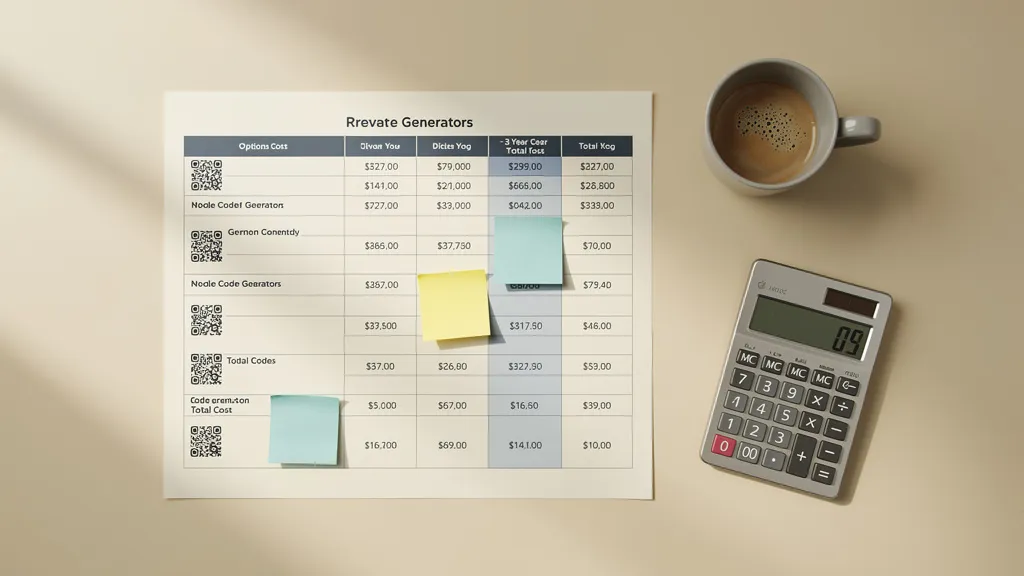
3-Year Pro Plan Total Cost
Sticker monthly times 36, no discounts:
- Quality QR Pro: €5/mo × 36 = €180 (about $216)
- Bitly Core: $10/mo × 36 = $360 (billed annually only)
- Canva Pro: US$144/year × 3 = $432 (Canva's pricing page shows the yearly price; we could not confirm its monthly price)
- QR Tiger Regular: $15/mo × 36 = $540
- ME-QR Lite: $16.99/mo × 36 = $611.64 ($378 at $10.50/mo billed yearly; ads on all but 1 code)
- QRFY (12 month plan): $19/mo × 36 = $684 (billed $228 a year; on 3 month billing, $39/mo × 36 = $1,404)
- Beaconstac Starter: $49/mo × 36 = $1,764
- Flowcode Pro: ~$60/mo × 36 = ~$2,160
The 10x spread. The most expensive Pro-tier plan in this category costs roughly ten times the cheapest. That gap reflects target market positioning more than feature parity, which becomes clearer when you normalize for what each plan actually includes.
Per-Dynamic-Code-Per-Month: The Real Cost Metric
Sticker price alone is misleading because plans include wildly different numbers of dynamic codes. The number that actually matters is the price you pay per dynamic QR code per month. That is the unit of work, because each dynamic code corresponds to one printed surface in the real world.
Using each vendor's stated dynamic-code limit on the Pro tier:
- QR Tiger Regular: $15 ÷ 30 codes = $0.50 per code per month
- Quality QR Pro: €5 ÷ 10 codes = €0.50 per code per month (about $0.60)
- Beaconstac Starter: $49 ÷ 10 codes = $4.90 per code per month
- Flowcode Pro: ~$60 ÷ ~10 codes = ~$6.00 per code per month
QRFY is left out of this rank because its one plan has no code limit: at $19 a month for unlimited dynamic codes, its cost per code keeps falling as you add codes ($0.19 a month each at 100 codes), and it beats the best rate above ($0.50) once you run 39 or more codes on its yearly plan. Our QRFY comparison sets its plan against ours feature by feature.
Canva and Bitly are excluded from this rank: Canva has added dynamic QR codes, but its pricing page states no dynamic code allowance for any plan, and Bitly's Core plan counts 5 new QR codes a month rather than a pool of active dynamic codes, with only 5 destination changes a month, so its quota does not compare directly.
On the per-code metric, QR Tiger leads on raw quota efficiency. If your workload genuinely uses every code its plan includes, QR Tiger Regular is the lowest cost-per-code option in this set. The honest caveat: most teams underuse their plan's code quota by 60% or more, so the relevant question is whether you actually need 30 simultaneously active dynamic codes.
The Free-Tier Durability Test
Sticker price ignores a category the industry does not like to talk about: does the free tier still work in 36 months? A free QR code that expires is worse than no QR code, because the printed surface keeps existing while the redirect goes dead, and you only find out when a customer scans.
Free-tier policies as documented on each vendor's public terms:
- Quality QR free: Codes never expire. 1 dynamic code and 5 static codes work indefinitely on the free plan. Free survives 36 months for both static and dynamic use.
- QR Code Monkey: Free static codes are not redirects, so 'expiration' does not apply. They keep working forever because the URL is encoded directly into the QR pattern. Free survives 36 months for static use only.
- Canva: Static codes encode the link directly, so they keep working. Canva has added dynamic codes, but its help center lists editable links and scan insights only for its Business, Enterprise and Nonprofit plans, and we could not confirm how long dynamic codes made on the free plan stay active. Free survives 36 months for static use.
- QRFY: No free plan. Dynamic codes made in its 7-day trial stop working when the trial ends and lead to a QRFY service page until you subscribe. Free does not survive 36 months.
- QR Tiger: Free plan includes 3 dynamic codes, each capped at 500 scans, with a QR TIGER ad shown on scan. QR Tiger states no time limit for them, but a code that keeps getting scanned can outgrow the free plan well before 36 months.
- Beaconstac: No genuine free tier. 14-day trial only.
- Bitly: Free tier includes 2 QR codes a month, but with no redirects (you cannot change where they point) and no scan history. Bitly's pricing page does not say how long they stay active, so we do not count it as a free tier that survives.
- ME-QR: Free plan codes have unlimited lifetime and unlimited scans, according to ME-QR's pricing page, but every free code shows ads to the people who scan it. Free survives 36 months, with ads (our ME-QR comparison shows which ME-QR plans remove them).
- Flowcode: Free tier is heavily restricted; full dynamic functionality requires a paid plan.
If you start on a free tier today and want the QR codes you create today to still work in 2029, the only options that survive cleanly, without ads, are Quality QR (static and dynamic), QR Code Monkey (static only), and Canva (its static codes). ME-QR's free codes also keep working, but every one of them shows ads.
What This Means For Real Buyers
The buying decision is not 'which is cheapest per month.' It is a function of three variables:
- How many dynamic codes do you actually need in active use? (Most teams overestimate.)
- How long will your printed materials live? (Often longer than the SaaS plan.)
- What happens if a code stops working? (Reprint cost, brand damage, customer confusion.)
Three buyer profiles:
Profile A: The minimal user. You need 1 to 2 dynamic codes for a small business. Your printed materials live 2 to 3 years. Cost over 36 months matters; reprinting is painful. The two viable options are Quality QR free (€0 over 36 months for 1 dynamic code) or Quality QR Pro at €180 for 10 dynamic codes. Free is actually free here. If a one-time fee for a single code tempts you instead, the dynamic QR code price comparison weighs one such deal against a free code.
Profile B: The growing team. You need 8 to 15 dynamic codes for a marketing team running multiple campaigns. Your printed materials live 1 to 3 years. If 10 codes cover you, Quality QR Pro costs €180 over 36 months. If you need 11 or more, Quality QR Business covers up to 100 dynamic codes for €360 over 36 months (about $432), which is still less than QR Tiger Regular at $540 for 30 codes.
Profile C: The enterprise buyer. You need 50 to 100 dynamic codes, team collaboration, custom domains, and procurement-friendly contracts. The realistic comparison is Quality QR Business (€10/mo × 36 = €360, about $432) versus Beaconstac Business ($99/mo × 36 = $3,564) versus Flowcode (custom pricing, typically several thousand annually). The 3-year cost gap is more than $3,000. Make sure the procurement constraints actually require the more expensive vendor before paying for them.
Honest Caveats
Annual discounts vary. Most vendors offer 10 to 20 percent off for annual prepay. We did not factor this in because not every customer pays annually, and the discount structures differ widely. If you intend to prepay, knock 10 to 20 percent off the totals above; the rank order does not change. Quality QR's yearly billing takes 20 percent off: Pro comes to €144 over 36 months (€48 × 3) and Business to €288 (€96 × 3).
Prices change. Competitor prices reflect public listings as of May 2026 (Bitly's, ME-QR's and Canva's as of October 2026), and Quality QR's as of October 2026. Vendors raise and reduce prices periodically. The conclusions in this analysis are about price ratios and structural differences, which tend to persist even when individual prices shift.
Feature gaps matter. Lower sticker price often means narrower feature set. The 'cheapest' generator that does not have the features you need is more expensive than the one that does, because you end up paying twice or reprinting. Do the cost math after you have validated feature fit, not before.
This is sticker math, not TCO. Total cost of ownership also includes reprinting after free-tier expiration, time spent fighting cancellation flows, time spent dealing with failed scans, and the cost of brand damage from broken redirects. Those are harder to quantify, but they push the analysis even further toward generators with documented no-expiration policies.
The Quality QR Position
We are biased. We built Quality QR to win on the metrics that matter once you do the multi-year math: a free tier that survives, transparent pricing that does not change after signup, and feature breadth (A/B testing, scan-velocity alerts, design templates, version history with rollback) that on most other platforms requires the highest tier or a sales call.
If you want to test the math yourself, our pricing page shows full plan details with no signup required, and our alternatives page documents each competitor's pricing alongside ours. The numbers in this article all come from those public sources.
Whether you choose Quality QR or someone else, do the 3-year math before you commit. The hidden cost is rarely in the monthly price.